- Overview
- Application
- Key Features
- Specification
- Download
- Related Products
High Performance VDSL2 Data Rate over Existing Phone Lines
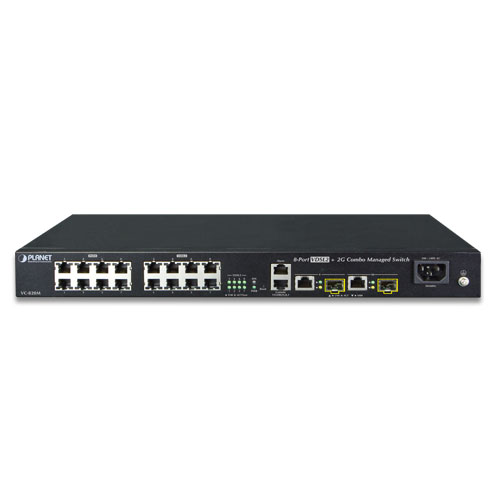
PLANET VC-820M is an 8-Port VDSL2 Managed CO (Central Office) Switch with 2 Gigabit TP/SFP combo interfaces. The VDSL2 CO Switch is perfectly designed for the networking applications of communities, network service providers, SIs, IP surveillance providers, etc. It is based on two core networking technologies, Ethernet and VDSL2 (Very-high-data-rate Digital Subscriber Line 2). Worked with PLANET VC-23x series of VDSL2 CPE (Customer Premises Equipment), the VC-820M offers the absolutely fastest data transmission speeds over the existing copper telephone lines providing an ideal solution to the last-mile connectivity.
Each VDSL2 interface of the VC-820M provides two copper phone ports, one for VDSL2 connection and the other one for POTS (Plain Old Telephone Service) connection. To share the existing phone line with POTS, the VC-820M has a built-in POTS splitter that helps the voice over telephone and network data to transmit over the same wire without being interrupted. | | | | | | | | | | | | | | Delivering Highly-demanding Connectivity for ISPs/Triple Play Devices
As the demand for home broadband connections increases, the VDSL2 technology is the next media to support the integration of home services and provides a significant transmission speed faster than that of the current cable modem and ADSL technology. The VC-820M applies the EoVDSL (Ethernet over VDSL) to providing up to 100Mbps download capability and makes the following multi-media services more efficient on the local network:
■ IPTV/HDTV
■ VoD (Video on Demand)
■ Voice over IP
■ Video Conferencing/Video Phone
■ On-line Gaming
■ Internet Radio/On-line Music
■ Long-distance Education
The VC-820M offers an excellent bandwidth to meet the requirements of the triple play devices for home entertainment and communications. | | | | | | | QoS Features to Ensure Best Performance
The VDSL2 Switch contains robust QoS features such as port-based, 802.1p priority and IP ToS/DSCP to ensure the best performance of its VoIP and video stream transmission, thus empowering the enterprises to take full advantage of the limited network resources.
Selectable VDSL2 Data Rate for Service Differentiation
Through the management interface, the administrator can control the data transmission speed of each VDSL2 interface. Telecoms and ISPs can immediately and remotely upgrade/downgrade bandwidth service upon different demands.
Efficient Management
To further expand the current network, PLANET VC-820M provides console and Telnet command line interfaces, and advanced Web and SNMP management interfaces. With its built-in Web-based management interface, the VDSL2 switch offers an easy-to-use, platform-independent management and configuration facility. The VDSL2 switch supports standard Simple Network Management Protocol (SNMP) and can be monitored via any standard-based management software. For text-based management, the VDSL2 switch can also be accessed via Telnet and the console port. Moreover, the VDSL2 switch offers secure, remote management by supporting Secure Socket Layer (SSL) connection, which encrypts the packet content at each session. The features above provide an efficient way to manage the devices from the internet environment with no need to add extra secure system either by means of hardware or software. | | | | | | | Robust Layer 2 Features
For efficient management, via Web interface, the VC-820M can be programmed for basic switch management functions, such as port speed configuration, port link aggregation, IEEE 802.1Q VLAN and Q-in-Q VLAN, port mirroring, Rapid Spanning Tree, and ACL security. Additionally, the firmware includes advanced features such as IGMP snooping, QoS (Quality of Service), broadcast storm and bandwidth control to enhance bandwidth utilization.
Advanced Security
The VDSL2 switch offers comprehensive Layer 2, Layer 3 and Layer 4 Access Control List (ACL) to filter out unwanted traffic. Its protection mechanisms comprise RADIUS and port-based 802.1X user and device authentication. Moreover, the VDSL2 switch provides MAC filter, static MAC, IP/MAC binding and Port Security for enforcing security policies to the edge. The administrators can now construct highly-secured corporate networks with considerably less time and effort than before. | | |
MTU/MDU/Hospitality Solution
IPTV, VoD and digital message broadcasting services are the worldwide hot trends, and more and more service providers have gradually upgraded the client-side devices from analog system to digital system. PLANET VC-820M VDSL2 CO Switch and VC-23x VDSL2 CPEs are the best solutions to quickly providing cost-effective and high-speed network services by utilizing the existing telephone wire infrastructure. IP network installation is straightforward and requires no new wiring. With enough bandwidth, the VC-820M with up to 100/100Mbps symmetric capability enables to make multi-media services on the local Internet, such as VoD (Video on Demand), Voice over IP, video phone, IPTV, distance education and so on, more efficient. This kind of infrastructure will minimize the burden on the Internet. | | | | | | | | | | | | | | Last Mile of FTTx Deployment
The VC-820M provides an symmetric data rate of up to 100/100Mbps within 300m and in long-range connections, where the performance of the pervasive telephone line network can be ultimately enhanced. With the two built-in mini-GBIC 1000BASE-SX/LX SFP (Small Form-Factor Pluggable) interfaces, the deployed distance of the VC-820M can be extended from 550 meters (multi-mode fiber) to 10/50/70/120 kilometers (single-mode fiber). The various distances of SFP and Bidi (WDM) transceivers are optional for customers. The long-distance support feature makes the VC-820M a great and ideal solution for FTTx (Fiber to the Building, Fiber to the Campus or Fiber to the Home) applications. It supports high-bandwidth VDSL2 over the existing telephone wires in the “last mile” from the ISPs’, telecoms’ and service providers’ fiber nodes to the buildings and customers’ homes. | | | | | | | | | |
VDSL Interface- 8 x RJ11 connectors for VDSL2 connection
- 8 x RJ11 connectors for POTS connection
- Built-in POTS splitter for each VDSL port
- Auto-speed function for VDSL2 link (by distance and cable quality)
Ethernet Interface- 2 Gigabit TP and SFP shared combo interfaces
- Auto-MDI/MDI-X detection on Gigabit RJ45 port
VDSL2 Features- Cost-effective VDSL2 link and central management solution
- ITU-T G.993.2 VDSL2 standard
- DMT (Discrete Multi-Tone) line coding VDSL
- Up to 100/100Mbps symmetric data rate
- Copper wiring distance up to 1km
- Selectable target data rate and target SNR margin
- Built-in surge protection against surge damage from high energy spike
- Voice and data communication can be shared on the existing telephone wire simultaneously
- Supports downstream/upstream rate control on each port
Layer 2 Features- High performance of Store-and-Forward architecture and runt/CRC filtering eliminate erroneous packets to optimize the network bandwidth
- Broadcast/multicast/unicast storm control
- Supports VLAN
- - IEEE 802.1Q tag-based VLAN
- - Port-based VLAN
- - Q-in-Q tunneling (VLAN stacking)
- - GVRP for dynamic VLAN management
- - Private VLAN edge (PVE/protected port)
- Link Aggregation
- - IEEE 802.3ad LACP (Link Aggregation Control Protocol)
- - Cisco ether-channel (static trunk)
- Spanning Tree Protocol
- - STP, IEEE 802.1D
- - MSTP, IEEE 802.1s
- Port mirroring to monitor the incoming or outgoing traffic on a particular port
Quality of Service- 4 priority queues on all switch ports
- Traffic classification:
- - IEEE 802.1p CoS
- - IP ToS/DSCP
- - Port-based priority
- Strict priority and Weighted Round Robin (WRR) CoS policies
Multicast- Supports IGMP snooping v1 and v2
- IGMP querier mode support
Security- IEEE 802.1X port-based network access control protocol
- RADIUS users access authentication
- L2/L3/L4 Access Control List (ACL)
- MAC filtering and source IP-MAC/port-binding
- Port security for source MAC address entries filtering
Management- Switch Management Interface
- - Telnet command line interface
- - Web switch management
- - SNMP v1, v2c, v3 switch management
- - SSL switch management
- DHCP client for IP address assignment
- Link Layer Discovery Protocol (LLDP) for easy network management
- DHCP option82 and DHCP relay
- Built-in Trivial File Transfer Protocol (TFTP) client
- Firmware upgrade via TFTP or HTTP
- Configuration upload/download via TFTP or HTTP
- Four RMON groups 1, 2, 3, 9 (history, statistics, alarms and events)
- SNMP trap for interface Link Up and Link Down notification
- Reset button for system management
- RJ45 console interface for switch basic management and setup
| | |
| Hardware Specifications |
| Hardware Version |
2.0 |
| VDSL Interface |
8 VDSL2 RJ11 interfaces
8 POTS RJ11 interfaces |
| Copper Ports |
2 10/100/1000BASE-T RJ45 auto-MDI/MDI-X ports |
| SFP/mini-GBIC Slots |
2 1000BASE-X SFP interfaces, shared with Port-9 and Port-10 |
| Console |
1 RS232-to-RJ45 serial port (115200, 8, N, 1) |
| Transient Voltage Suppressor |
IEC 61000-4-2 (ESD): ±15kV (air), ±8kV (contact)
IEC 61000-4-4 (EFT): 40A (5/50ns)
IEC 61000-4-5 (Lightning): 24A (8/20μs) |
| Switch Architecture |
Store-and-Forward |
| Switch Fabric |
5.6Gbps/non-blocking |
| Switch Throughput |
4.16Mpps @64 bytes |
| Address Table |
8K entries |
| Shared Data Buffer |
256K bytes |
| Maximum Frame Size |
9K bytes |
| Flow Control |
Back pressure for half-duplex
IEEE 802.3x pause frame for full-duplex |
| LED |
VDSL2, PWR, SYS, LNK/ACT, 1000 |
| Reset Button |
< 5 sec: System reboot
> 10 sec: Factory default |
| Dimensions (W x D x H) |
404 x 174 x 44.5 mm, 1U height |
| Weight |
2.4 kg |
| Power Requirements |
100~240V AC, 50-60 Hz |
| Power Consumption/ Dissipation |
36 watts (max.)/112.8 BTU/hr |
| VDSL2 |
| VDSL2 Standard |
Complies with ITU-T G.993.1 and G.993.2.
Supports provisioning the VDSL optional band (25K to 138K Hz) usage |
| Band Plan |
Selectable band plan for each VDSL line on a per port basis
Band Plan A:
- Profile 998, Annex A of G.993.1; optimized for symmetric services
Band Plan B:
- Profile 997, Annex B of G.993.1; optimized for asymmetric services |
| Profile |
Selectable spectrum profile of 8a/b/c/d, 12a/b, 17a, and 30a for frequency bands (Annex A, B and C) defined in G.993.2 |
| Encoding |
VDSL-DMT |
| VDSL2 Features |
Selectable rate limit control
Selectable target SNR (Signal to Noise Ratio) mode
POTS voices passthrough |
| Layer 2 Function |
| Management Interface |
Console, Telnet, Web browser, SSL, SNMP v1, v2c, v3 |
| Gigabit Port Configuration |
Port disable/enable
Auto-negotiation
10/100/1000Mbps full and half duplex mode selection
Flow control disable/enable |
| Gigabit Port Status |
Display each port’s speed duplex mode, link status and flow control status
Auto-negotiation status, trunk status |
| Port Mirroring |
TX/RX/both
1 to 1 monitor |
| Bandwidth Control |
Ingress/Egress rate limit control
Gigabit Port:
• Allow to configure per 128Kbps
VDSL2 Port:
• Allow to configure per 5Mbps |
| VLAN |
IEEE 802.1Q tag-based VLAN, up to 256 VLANs groups, out of 4094 VLAN IDs
Port-based VLAN
GVRP, up to 128 dynamic VLAN groups
Q-in-Q tunneling
Private VLAN Edge (PVE/Protected port) with two protected port groups |
| Link Aggregation |
Static port trunk
IEEE 802.3ad LACP (Link Aggregation Control Protocol)
Supports 13 groups with 8 ports per trunk |
| QoS |
4 priority queue
Traffic classification based on
- Port priority
- 802.1p priority
- DSCP/TOS field in IP Packet
VoIP QoS by application protocol no. |
| IGMP Snooping |
IGMP (v1, v2) Snooping, up to 256 multicast groups |
| Access Control List |
IP-based Layer 3/Layer 4 ACL
Up to 220 ACL rule entries |
| Security |
Port Security (Disable per port of MAC address learning)
Static MAC, MAC filter, IP/MAC binding |
| SNMP MIBs |
RFC 1213 MIB-II
RFC 2863 Interface MIB
RFC 2665 EtherLike MIB
RFC 1493 Bridge MIB
RFC 2819 RMON MIB (Group 1, 2, 3,9) |
| Standards Conformance |
| Regulatory Compliance |
FCC Part 15 Class B, CE, VCCI |
| Standards Compliance |
IEEE 802.3: 10BASE-T
IEEE 802.3u: 100BASE-TX
IEEE 802.3z: 1000BASE- SX/LX
IEEE 802.3ab: 1000BASE-T
IEEE 802.3x: Flow control and back pressure
IEEE 802.3ad: Port trunk with LACP
IEEE 802.1D: Spanning Tree Protocol
IEEE 802.1w: Rapid Spanning Tree Protocol
IEEE 802.1p: Class of Service
IEEE 802.1Q: VLAN Tagging
IEEE 802.1x: Port Authentication Network Control
ITU-T:
G.993.1 (VDSL)
G.997.1
G.993.2 VDSL2
RFC 768: UDP
RFC 793: TFTP
RFC 791: IP
RFC 792: ICMP
RFC 2068: HTTP
RFC 1112: IGMP v1
RFC 2236: IGMP v2 |
| Cables |
• VDSL2: twisted-pair telephone wires (AWG24 or better) up to 1km
• 10/100BASE-TX: 2-pair UTP Cat.5, up to 100m (328ft)
• 1000BASE-T: 4-pair UTP Cat.5E, up to 100m
• 1000BASE-SX: 50/125µm and 62.5/125µm fiber-optic cable, up to 550m
• 1000BASE-LX: 9/125µm fiber optic cable, up to 10km 50/125µm and
62.5/125µm fiber-optic cable, up to 550m |
| Environment |
| Operating |
Temperature: -10 ~ 50 degrees C
Relative Humidity: 10~ 90% (non-condensing) |
| Storage |
Temperature: -20 ~ 70 degrees C
Relative Humidity: 10~ 90% (non-condensing) |
Datasheet
| Date |
Version |
Description |
Download |
| 2016-01-08 |
1.0 |
VC-820M
|
 |
Quick Guide
| Date |
Version |
Description |
Download |
| 2015-12-11 |
2.0 |
Release for hardware version 2.0.
|
|
User's Manual
| Date |
Version |
Description |
Download |
| 2015-12-11 |
2.0 |
Release for hardware version 2.0.
|
| |
| Photo |
Model |
Description |
 |
MGB-Series Transceiver |
1000Base-SX/LX SFP Transceiver |
 |
VC-231 |
Ethernet over VDSL2 Converter (Profile 30a) |
 |
VC-234 |
4-Port Ethernet over VDSL2 Bridge (Profile 30a) |
 |
VDR-300NU |
300Mbps Dual Band Wireless VDSL2 Router |
|